
Analysing Sentences
Using code to help with editing
As I first mentioned in The Editor’s Assistant, I’ve been writing macros for MS Word for many years.
A little more than ten years after I wrote the macro mentioned in that post, I encountered the concept of “Glue Index” (and therefore “sticky sentences”). Also, around the same time, I discovered the existence of guidelines for balanced sentence length to aid comprehension and “comfortable” reading.
While this varies by audience and the nature of the writing, and – with fiction – from genre to genre, as a general principle it’s wise to keep average sentence length to between 20 and 25 words. Variety is good too. You don’t want large collections of short sentences, which can make the read feel “choppy”. It’s good for action passages, to give a sense of urgency/danger/etc, but you can’t keep that up for too long. It’s emotionally exhausting. Similarly long passages of overlong sentences can tire a reader out, or even worse annoy them. Hence “average.”
If you’ve read that previous post it’ll come as no surprise that I coded this up.

My AnalyseSentences macro runs through a document counting the words in each sentence and adding them to an Excel table, after which it’s easy to create the kind of graph seen above. In this case it’s a run against my latest manuscript – A Flame In The North – which currently sits at 107,000 words. The run took eleven minutes.
From that visual it’s easy to see that the average sentence length is somewhere around 10-15 words*, which is great, but you can also see quite a few outliers. Several between 50-60 words and one behemoth of over 70 words. This is another drafting tic. I will have let my mind run riot while writing, just basically recording a kind of stream of consciousness. It clearly needs some serious editing!
But help is at hand, because as well as writing these sentence lengths into Excel, AnalyseSentences highlights the long sentences it finds, so it’s easy to scan through the document, find them, and chop them up a bit.
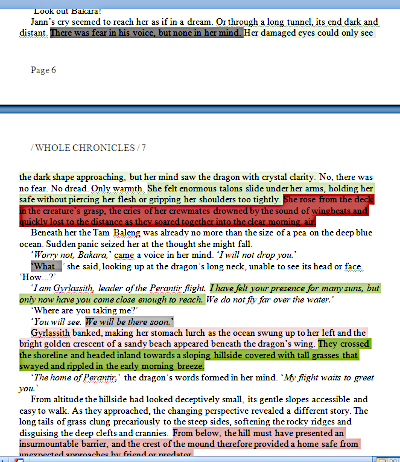
I use red for long sentences – anything over 25 words – and cycle through four different shades of red because often consecutive sentences have the same problem and this method makes it easier to differentiate them. I’ll read each one and decide whether it can stay as it is (for example if it’s one long sentence in a group of shorter ones), or needs to be split up. Run-on sentences are particularly easy to handle in this context – they are almost always stronger when split into two parts.
I also flag “outlier” sentences (longer than 50 words) in bright red because I can’t allow them to persist into the published work. They have to be split up or rewritten.
Sticky Sentences
Since this macro is handling sentences, I also calculate the Glue Index (you can Google it) of each one and highlight any that have a GI of 45% or higher in grey. Once again I cycle through four shades of gray (not 50!) for clarity. With short sentences (5-10 words) the GI is often unrepresentative. They’re not usually a problem. But many longer ones with high GI can be strengthened and I do switch some of them up during the read through.
Poor Style
Finally, four shades of green highlight two style issues: starting a sentence with a pronoun, or with a participle (I simply check for any word ending -ing). These aren’t hard-and-fast grammatical rules. Years ago some grammarians frowned on pronoun starts, but it’s very common in fiction and no longer considered a problem. But like so many things, it can be overdone, and this is especially true when drafting. Too much “he did this, she did that, they did the other” becomes repetitive and boring. So I flag them up for consideration, while at the same time being conscious that many (most) of them won’t need changing.
It’s a similar story with participles. “Rounding the corner, I encountered a man in a dark jumpsuit and a mask.” No problem. But again a little of this goes a long way. If every sentence starts like that it can be mind-numbing. And there’s the constant danger of dangling participles. Ain’t nobody needs that! So here again the highlighting draws my attention to something that may need to be checked out, but which will probably be OK.
*Having all the data in Excel makes it very easy to calculate this post-hoc. The actual average sentence length for this novel is 11.2 words.
Addendum: a sad glitch with Word2007
Shortly after I first wrote AnalyseSentences in 2019, I added a dialog box at the start of the run to make to analysis a little more flexible.
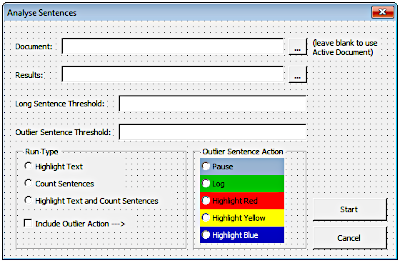 This made it easier to vary where the results were recorded, and change the values of the sentence lengths (defaulted to 25 and 50 as mentioned above) that would be flagged. It worked fine for several years, until…
Earlier this year when I attempted to run it against A Shadow On The Water. It crashed Word. I didn’t have time to diagnose the problem back then, but I have now. It crashes on the point of displaying this dialog.
I had a few attempts at fixing the fault, but in the end I’ve concluded it’s probably down to my set-up. I’m still using Word 2007 – 17 years old and out of support for some time. My PC runs Windows 2010 and the .NET framework too has changed considerably, so it’s seems likely that some combination of all of that makes the dialog barf.
But in all honesty moving away from the defaults was only a “nice to have.” It was a simple change to comment out use of the dialog, and set all the default values in a short chunk of code, which is easy to change if I ever feel the need to wander off piste. In that revised state, it runs just fine. But it does give me sad face to see physical evidence that my time using Visual Basic to make some aspects of life easier may be coming to an end.
Karbekidi – A Game of Stones

The Tam Baleng – Deck Plan

Kilautan – The Silver Sea
The Northern Territories
The Editor’s Assistant
Skills Reuse
I’ve been writing macros for MS Word since version 2.0, long before “Word Basic” was reinvented as Visual Basic, and before the Word object model was surfaced. I automated pretty much the entire document set for our OS development team from 1990-95. Away from work, I gradually developed a substantial code suite to support my 20-year role as a correspondence course tutor – onboarding, progressing, marking, and terminating student registrations and recording those marks (Excel integration!), calculating averages and updating a dashboard of historical stats (yeah, I’m a stats nerd too).
So it was a natural step, when I started writing, to apply these skills to my manuscripts to help with some of the editing. Some powerful author/editor tools are available online – I don’t need to mention them by name – but they’re not cheap. And I am. So I fall back on a home-grown alternative, “leveraging” the skills available to me.
Recently, I reached that editing step in my WIP: running some code I’ve given the snappy title of MarkDeprecatedWords against the 120,000 word m/s.
 When it’s finished, it appends this report to the last page of the document. The word count is inflated owing to a quirk of the Word object model. It counts all sorts of extra fragments as a “word” – the most obvious example that springs to mind (if my memory is accurate) being the punctuation at the close of a speech. Usually something like comma-close-quote or period-close-quote.
The highlights in this image are peppered throughout the text ready for me to do another pass, examining each and deciding what to do about them.
Proximity Words
I’m particularly pleased with this one. I noticed early on in my writing career that when I’m drafting, words tend to get “stuck” in my mind, and I’ll use them again pretty soon after the first instance. I don’t like this – it reads very clunky, and inaccurately suggests a paucity of vocabulary, when really it’s nothing more than a drafting tic. It comes from writing in “creative mode” with my inner editor silenced, which is how first drafts should be written. This highlighting merely serves as a helper to the editing pass to flag them up.
So the code maintains a rolling array of 40 words (an arbitrary size), against which it checks each new word it deals with. After ignoring common words like the, and, etc, any hits are highlighted in Pink. If the word isn’t found, it’s added to the array, retiring the oldest unmatched word once the array is full.
Adverbs
I don’t have as much antipathy towards adverbs as my younger daughter, but they can be a warning flag for telling, rather than showing. This part of the check is very basic: it simply looks for words ending “-ly” after ignoring obvious candidates like only, family, early, etc. Obviously (lol) not all of these are adverbs, but many are. Flagging them up (in Green) helps decide whether the text needs changing to avoid their use.
Noise and Quirk Words
Two further drafting tics of mine and, I suspect, many writers: including noise words (just, really, that, very, quite, …) and other useless modifiers, along with a list of personal words I tend to overuse. Things like rictus, habitually, haunted, erstwhile, denizen, etc really ought to be used only once or twice per manuscript (if at all, lol).
This list grows by 3-4 with each new work. They’re highlighted in Teal.
Poor Style
This is mainly a check for three things: passive voice; overt thinking; and laziness.
I don’t know about you, but I have a habit of dropping into passive voice when drafting, and for the final work I’d prefer to avoid it wherever possible. There are rare occasions when a sentence would have to be run through a spiralizer, and then a blender, and then flattened by a couple of passes through a pasta maker, before you can wrangle it into something without p.v. If that’s the case I’d leave it as is. But mostly, it can be rewritten stronger and better.
Words like thought, pondered, realised, etc, are evidence that you’re documenting the MC’s thoughts. Since the reader is already in the head of the thinker (at least, in the POV I write in), thoughts should simply be expressed directly. “He thought,” or “she realised” needs mostly to be avoided.
The laziness check covers words like went and got. I saw a writer’s meme once that listed the 200 alternatives to “went”, and I’m sure got has an equivalent list.
All these style checks are highlighted in Turquoise.
Once this run is complete, the follow-up editing task involves donning my sunglasses against the glare of all these highlights, and going through the text making all the necessary corrections. You won’t be surprised to learn I have another very small, but very handy macro for removing highlighting.
Addendum on the Word Object Model
When I first wrote MarkDeprecatedWords, I was in a hurry and knocked it up the way that seemed most obvious at the time. The words in a document can be accessed as an array, and that’s what I used first: Document.Words(I), for incrementing values of I.
The first time I ran it against a 100,000 word manuscript it took 36 hours to complete. I added (belatedly, I admit), some metrics, which demonstrated quite graphically that the code was running slower and slower over time.
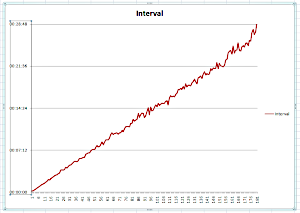 Recording a timestamp for each successive 1,000 words showed increasing intervals as it chewed through the document.
Seemed pretty obvious to me that the Word developers had not been very creative in their implementation of that array of words. Possibly not really expecting anyone to use it. The most likely explanation for the ongoing increase in interval, is that indexing the array counts through from “1” every time!
I sought out an alternative, and encountered the structure I should’ve been using from the start. The set of words. Changing the iteration from an indexed array to…
For Each objWord In docForMarking.Words
[ do some stuff ]
Next objWord
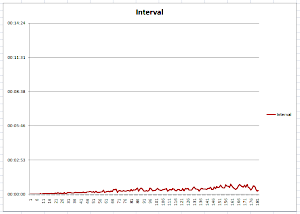 …had a radical effect on execution time. As you can see from the completion report at the top of this post, it can now zip through 156,000 “MS Word” words, or 120,000 actual words, in a little over half an hour.
The effect is even clearer when graphed up with the same 1000-word interval timings.
Fantasy Map
Language in SF & Fantasy – Part 2
Language Creation 1.01.
The creation of new languages for science fiction and fantasy works has a long and illustrious history, stretching back to 1895 and the language of the Eloi in H.G.Wells’ The Time Machine. More recent examples are legion. I first woke up to this several decades ago, when I discovered that Klingon had been developed into a language that could be learned and spoken, and that many people had, and did. Indeed with 21st century works bringing us such well known examples as Dothraki and High Valyrian from Game of Thrones, and the language spoken by the Na’vi in Avatar, not to mention countless others from the gaming world, building a fantasy language from the ground up has become so common that it now has its own job title: conlanger (“creator of a constructed language”).
Doing it on a Shoestring
 As an indie author, I don’t have access to the kind of resources those professionals use. But I wanted the Chronicles to have a credible element of language, as discussed in part 1 of this post. I set about developing a simple method to turn an existing language into the two I needed for the series. Without realising it at the time, I hit most of the tips that Amber Massey mentions in her “5 Tips for Creating Believable Fictional Languages” article.
Start with a Real Example
With apologies to any native speakers of Indonesian, I chose that language as one that was both unfamiliar to me, and available on Google Translate. I figured there was a pretty good chance it would not be all that well known among my readership either. This was yet another example of how much I rely on the Internet to craft my books. Having access to an instant translation of any word or phrase I wanted to include in my text has made this so much easier to achieve. In the days B.I. (Before Internet) I would’ve had to invest in an English-Indonesian dictionary (if one even exists!) and painstakingly assemble the translation of a phrase one word at a time.
Convert Language A to Language B
Having translated English to Indonesian, I didn’t want to stop there. It’s not a “new” language at that stage, is it? So the question was: how to munge the output from Translate into something that still looked like real words, but no longer quite so much like Indonesian.
Sometimes this would be as simple as switching the end of a word with its beginning, or reversing the order of the letters. Alternatively, where there is more than one translation for a word (as is quite common), I may use the end of one word with the beginning of another. A good example of this, since there’s a lot of magic in the Chronicles, is the word for spell. Indonesian words for incantation include mantera, and jampi. Taking the beginning of the latter and adding it to the ending of the former gave me the “Istanian” word for spell: jamtera.
Two Languages
As I mentioned in part 1, I intended the languages of the two realms in the Chronicles to diverge over the three hundred years before the story begins. To avoid labouring the language point, I assumed this divergence would not be so great as to render one language meaningless to speakers of the other. Indeed, during Jann’s journey north in Water Wizard, he discovers he can still understand the original “root” language spoken by the people who live beyond the mountain, which itself has diverged in a third direction during the intervening centuries.
So it made sense for words with similar meanings to also be similar, in Istanian and Kertonian. One of the main examples of this occurs in the military of the two realms, where the equivalent rank of captain is known as “hodak” in Kertonia, and “tepak” in Istania (both words derived from the Indonesian offered by Translate – kapten and nakhoda).
Amusing coincidences
Behind every Istanian word or phrase, there is a real Indonesian equivalent, and behind that an English starting point. When I was thinking of a name for the fruit that the forest workers snack on during their break, I started with the idea of a “bright red fruit.” Running that through Translate gave me the Indonesian terang buah merah. Applying my – by now standard – munging, adding the first syllable of the second and third words to the last syllable of the first, presented the first attempt at the Istanian: bumerang.
Language in SF & Fantasy – Part 1
English, English, Everywhere
One of the most common criticisms of SF/Fantasy is the uniformity of language on alien worlds, especially when compared to Earth. Estimates of the number of languages currently spoken vary between 6-7,000 and in the course of human history over 30,000 languages have existed at one time or another. And yet a majority of authors don’t worry about it.
That kind of thing bugs me. Right from the beginning, I decided it was unrealistic to
a) ignore the problem of language altogether and just have everyone speaking English with no explanation, or
b) have some awful McGuffin like Hitch-Hikers’ Guide’s “babel-fish” or Star Trek’s Universal Translator, or
c) have one all-encompassing language of “Berikatanyan” – kind of the logical equivalent of a language caller “Earther” or “Terran”
If not English, …?
 So I had to think about what languages would be spoken and how the Earthers interacted with their speakers. Fortunately, at the time Gatekeeper opens, the original two crews have been on planet for approaching nine years. This is easily long enough to learn the local language (as anyone who has elected to live in a foreign country will know), and also have parts of Berikatanyan society learn English. There is precedent for fluency in the visitors’ language being treated as a mark of rank or privilege, in the same way speaking French was seen in early English high society.
Thus the principal characters in the two realms would all be thoroughly familiar with English; other members of both courts would be passable but perhaps not fluent; and those who came into regular contact with Earthers (like the forest clearance units) would have “holiday” command of English, broken and halting with limited vocabulary but capable of understanding and making themselves understood.
Conversely, Earth people living at either Court or Palace would learn the native tongue and those coming into regular contact with Berikatanyans (but not living with them) would have a more basic grasp of one or other (or both) languages.
…what have you got?
Which brings us to the languages. I’ll describe how I went about “inventing” them in Part 2 of this post, but thinking about how they might arise in the world I’d built for the Chronicles, it’s legitimate to assume that warring tribes that developed independently and – in a primitive feudal society – would not meet each other very frequently, would have divergent languages even if they descended from a common ancestor, with a common tongue. An Earth equivalent would be the so-called Romance languages (Italian, Spanish, Portuguese, French, …) or Teutonic language (English, German) that have similar features but are effectively totally different languages. Since I allude to “two- to three-hundred years” of bickering between Court and Palace in Gatekeeper, and settle on a more definite 300 years in Water Wizard, this is easily enough time for the languages to have diverged.
Closer to home, the UK is well known for the diversity of its dialects, even over relatively short distances. In an area that includes where I live, stretching north and south by only 30 miles or so in each direction, you will find Liverpudlian (Scouse), Mancunian, Lancashire, Cheshire, Potteries (Stokie), and Birmingham (Brummie) to name but six. Not only do these regions vary in accent and pronunciation, but they also have many examples of dialect words that are not found outside their own small areas. So it’s entirely realistic that in an area the size of the peninsula where most of the Chronicles’ action takes place, and over a period of three hundred years, the language would develop into:
Kertonian: (from Indonesian keraton – palace)
Used in the Black Queen’s realms (therefore known as Kertonia)
and
Istanian: (from Indonesian istana – court)
Used in the Blood King’s realms (therefore known as Istania)
Too much of this is a distraction – similar to watching a film where an alien language is spoken and the subtitles are turned off (or not burned in) – so the Chronicles only has a few, short examples of each. A handful of local words are used more frequently, so they become familiar. On first appearance I include contextual explanations, and they can also be found in the handy Glossary. I hope it adds to the impression of a well-realised world.
How Do You Plot?
Having established that I’m a Plotter, how do I go about it?
Hacking your way through the jungle of plotting methods can be a struggle. A search on “how to plot a novel” will throw up several options. OK, “several” may be an understatement. I did that search just now and had almost 650 MILLION hits. From famous approaches like Snowflake, Save The Cat (which likes to call itself “The World’s #1 Storytelling Method), and John Truby’s 22 Steps to more esoteric home-grown methods, there are almost as many choices as there are writers. Some are more suited to screenplays than novels, some are available as books, or videos, many are supported by software tools and useful collateral such as beat sheets, character fact sheets, and checklists. With so many to choose from, there will be a method out there for you. And if there isn’t one that’s a perfect fit for your writing style, you’re always free to pick the best bits out of several and munge them together into Your Very Own Method, which is what I did, over time…
My Very Own Method

I started off with Snowflake. I liked the way it forces you to start out with the idea of your whole novel, encapsulated in a single sentence, and then break that down into ever greater levels of detail, which the graphic above attempts to illustrate, cleverly ending up looking like a snowflake. It really helps, later in the process, to have these short, snappy descriptions of the book which can do double duty in blurbs and back covers. One of the longer versions (Step 9 if you still use it, or slightly earlier) can also provide the majority of what you need for a detailed synopsis, should you wish to go down the “agent submissions” route.
At slightly further than halfway through the traditional Snowflake process, I start to diverge. Once I have a 4-page story outline (step 6) and a series of characters (step 7), I set off to create two sets of scenes.
Plot Scenes

A series of bite-sized chunks of story, each of which moves the main plot forward. The size of each scene, whether that’s in terms of the number of words that will need to be written, the elapsed time, or how much of the plot is covered, is up to you. I favour small scenes, with anything up to eight per chapter. I know a lot of writers prefer a single scene per chapter. I tend to go for a scene size that I can write in one session, because it takes time to get all the information into my head and once it’s there I want to get it done in one sitting.
The most recent example – book #3 of my fantasy trilogy The Berikatanyan Chronicles – had 78 plot scenes at the end of this phase.
Character Scenes
 That takes care of the main story, but each of the characters has their own story, or “character arc.” Although there are character types that don’t change during the course of a novel (static/flat, and stock characters are the most common examples) most of your main characters and certainly your hero/protagonist, will have something to learn, do, defeat, etc during the course of the story.
So for the character scenes I take these arcs and break them down in the same way I did for the plot. For Book #3 I had twelve characters I’d inherited from the first two books, one of whom is the main protagonist here, plus three new characters, giving me 109 character scenes in total, with the MP having most (15) all the way down to two minor characters with three each.
Overlap
Those of you who are still awake may have thought “but doesn’t some of the character action also move the plot forward?” Take a bonus point! Yes, of course, it does. So having assembled that long list of scenes, my next task is to trawl through them looking for overlap, and noting that in plot scene A, character B must do C, folding those scenes into a single combined scene description covering everything it needs to. I started this trawl for book #3 with those 187 scenes, and finished up, after removing duplicates, with 158.
Timelining
There is, obviously, a natural duration for each of these scenes. Some events, such as the disasters, may have a fixed point in time around which other events need to flex. Beyond that, my characters spend a fair bit of time travelling around. Unless something magic happens (which in a fantasy book isn’t beyond the realms of possible), travel time has to be accounted for. So having whittled down my list of scenes to its smallest number the next stage is to plug these into a timeline. I’m currently using Aeon Timeline for this, which is a great tool.

It’s only drawback, until recently, was the lack of integration with other tools, so having created all my scenes in Scrivener I recreate them manually in AT. Synchronising automatically between the two is now allegedly possible, but it’s a fairly new innovation and has caused problems for some writers, so I decided to avoid being sucked into yet another time sink and stuck with the manual method. For my next project I intend checking out Plottr, which (again, allegedly) gracefully combines the drafting and organising elements of Scrivener with the timelining abilities of AT.
With a fixed set of scenes laid out in a credible timeline, the final step is to divide them up into chapters. It’s no secret that books about which readers say “I couldn’t put it down” will end each chapter on some kind of cliffhanger, so there may be a bit of juggling the scene order, or the chapter divisions, to make it more difficult for the reader to stop reading at chapter end. Once that’s done, the plotting is finally finished and I’m ready to start the “real” writing.